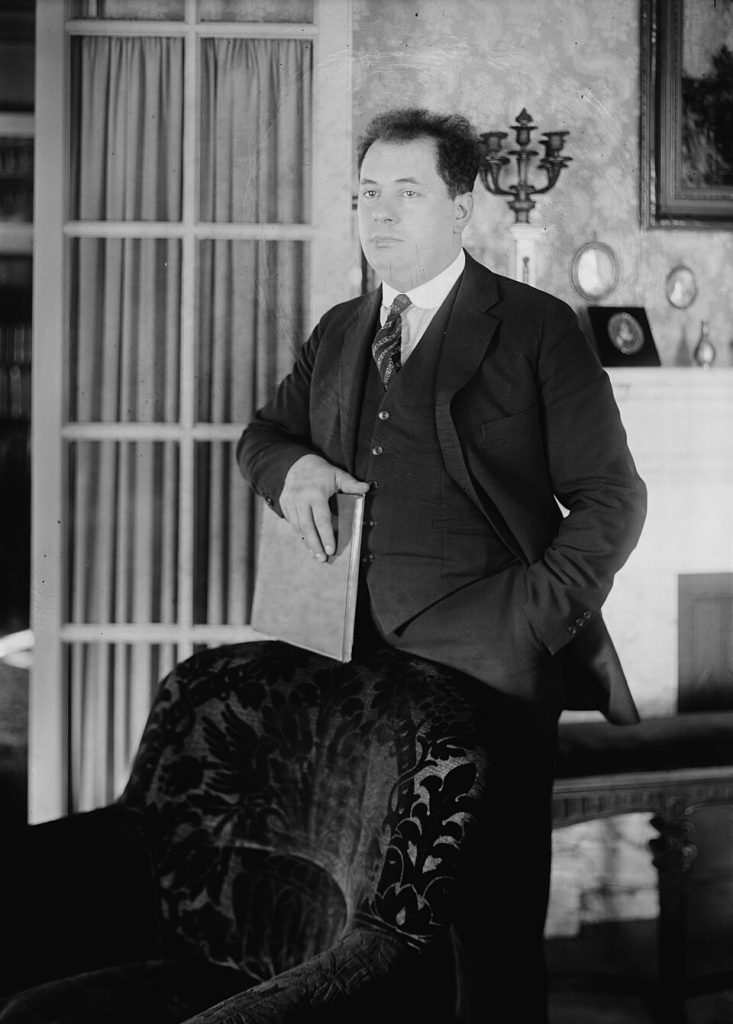
Ignatz Waghalter
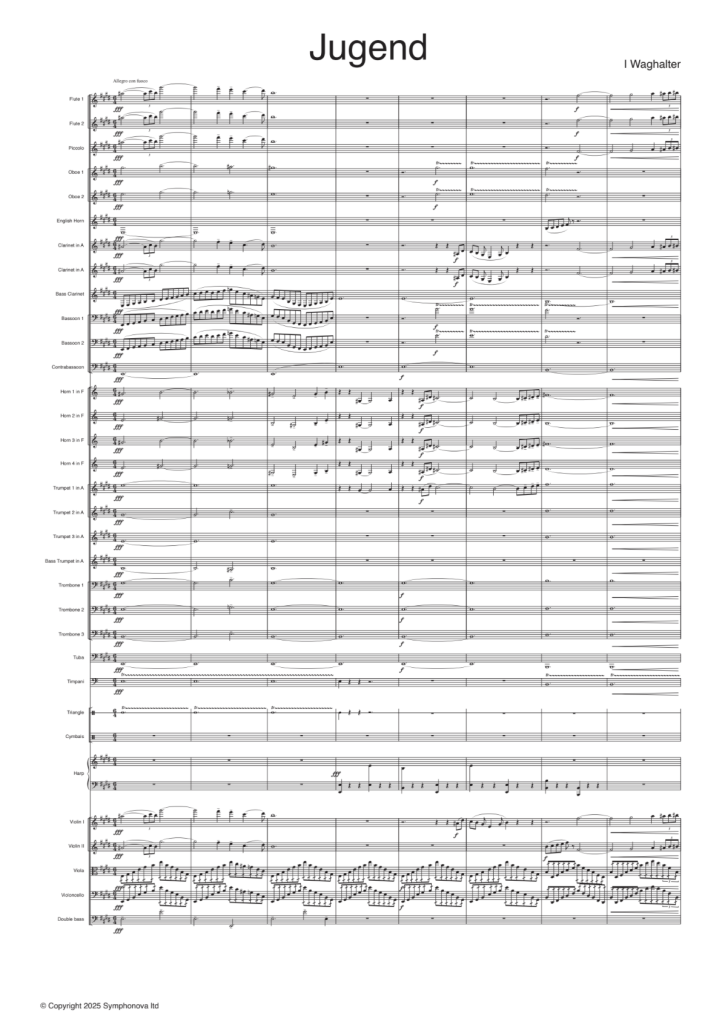
Opening of Act III from Jugend
Conducted by Shelley Katz using the Symphonova
Waghalter’s three-act opera Jugend (Youth), Op. 20, was based on Max Halbe’s celebrated 1893 Naturalist drama, with a libretto by Hans Richard Weinhöppel. It received its premiere at Berlin’s Deutsches Opernhaus on 17 February 1917, conducted by Waghalter himself.
The opera tells a tragic story of youthful love constrained by religious and social convention. At its centre are the young lovers Annchen and Hanns, whose relationship sets in motion a chain of jealousy and violence. In the third and final act, the drama reaches its catastrophic conclusion when Annchen is killed while attempting to protect Hanns.
Jugend was a considerable success, receiving more than forty performances during its first three years and remaining in the repertoire for several years. Yet it subsequently disappeared almost completely from the stage. A complete piano reduction was published by Drei Masken Verlag, while the full score survives in the Ignatz-Waghalter-Archiv at the Akademie der Künste in Berlin. Excerpts from Acts II and III were performed with piano at the Deutsche Oper Berlin in 1989, but no complete recording or modern orchestral revival of the opera has yet been identified.
The excerpt recorded by Symphonova is the 78-bar orchestral opening of the third act. Marked Allegro con fuoco, it launches the opera’s final act with urgent, highly charged writing for full orchestra. Waghalter exploits striking dynamic extremes, repeatedly building to fff and even ffff, giving the music an almost overwhelming intensity.
A contrasting tranquillo section briefly draws the music into a calmer sound world before the return of Tempo I restores the opening drama. In just 78 bars, Waghalter moves between intensity and repose, creating a compact but dramatically powerful orchestral introduction to the opera’s tragic final act.
Despite Jugend’s success on the Berlin stage after its 1917 premiere, we have so far found no evidence that this orchestral opening to Act III has previously been recorded. Heard again more than a century later, it offers a striking glimpse of a once-successful opera that has almost entirely disappeared from the repertoire.
Ignatz Waghalter (1881–1949) was a Polish-born Jewish composer and conductor whose successful career in early twentieth-century Berlin was followed by exile and the near-disappearance of much of his music.
Born in Warsaw into a large musical family, Waghalter moved to Berlin as a young man, where his talent was recognised by the celebrated violinist Joseph Joachim. He studied composition with Friedrich Gernsheim at the Prussian Academy of Arts and won the prestigious Mendelssohn Prize for his Violin Sonata. He subsequently established himself as both composer and conductor, becoming closely associated with the newly founded Deutsches Opernhaus in Berlin, where he served as a conductor from 1912 to 1923.
Waghalter was a gifted melodist who remained committed to an expressive, tonal, late-Romantic musical language at a time of rapidly changing musical aesthetics. His principal operas included Mandragola (1914), Jugend (1917) and Sataniel (1923), alongside orchestral, chamber and vocal works.
His subsequent neglect can be understood as the result of two overlapping forces. As musical modernism gained prominence, Waghalter’s unabashedly lyrical style increasingly fell outside prevailing fashions. This aesthetic marginalisation was followed by a far more destructive rupture. As a Jewish musician, Waghalter was forced from the German musical world by the rise of Nazism. After periods in Czechoslovakia and Austria, he emigrated to the United States in 1938, where he died in New York in 1949.
Waghalter was therefore not an obscure composer in his lifetime. He was an established figure in Berlin musical life whose works gradually disappeared from the repertoire through a combination of changing musical fashion, persecution and exile. The rediscovery of his music today reveals a distinctive musical voice whose neglect bears little relation to the success and esteem he once enjoyed.